
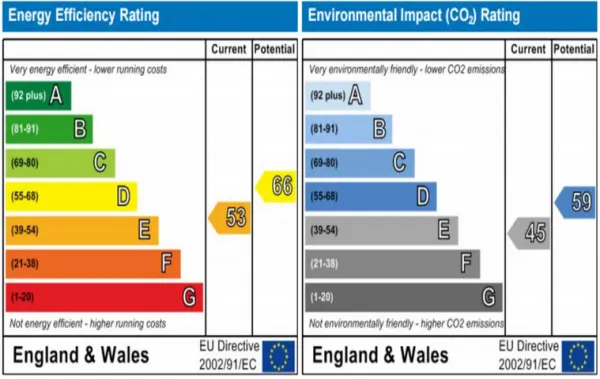
Regularly referred to as an EPC, the Energy Performance Certificate was introduced by the UK government in an attempt to undertake periodic audit of the UK’s built environment and to assess its energy efficiency and nudge/require* property owners to improve the energy efficiency of their property.
A property owner must have a valid EPC whenever a property is built, sold or let.
An Energy Performance Certificate contains:
- information about a property’s energy use and typical energy costs
- recommendations about how to reduce energy use and save money
- An EPC gives a property an energy efficiency rating from A (most efficient) to G (least efficient) and is valid for 10 years.
At present, the following buildings do not require an EPC:
- Places of worship
- Temporary buildings that will be used for less than 2 years
- Stand-alone buildings with total useful floor space of less than 50 square metres
- Industrial sites, workshops and non-residential agricultural buildings that don’t use a lot of energy
- Some buildings that are due to be demolished
- Holiday accommodation that’s rented out for less than 4 months a year or is let under a licence to occupy
- Listed buildings - you should get advice from your local authority conservation officer if the work would alter the building’s character
- Residential buildings intended to be used less than 4 months a year
- Unsafe properties
*Current regulations relating to EPCs include prohibition of the renting of property that does not have an energy rating of band E or better. Failure to comply with these regulations can result in significant fines of up to £5,000.
Related article:

Download our Free First Time Buyers Guide
Recent posts

There are several scenarios for a landlord where standard buy-to-let lending isn’t enough for their investment. For more complex properties, ownership structures, or borrowing circumstances, a specialist buy-to-let mortgage may provide options that are not available through mainstream lenders.
Best UK Mortgage Rates this Week
5 days ago

Here are the lowest fixed mortgage rates of the week, available to first-time buyers, home movers, buy-to-let, and those remortgaging.
Call us for more information: 01628 507477 or email: team@mortgagerequired.com.
Leaseholders to be given extra protection
19 days ago

Housing Secretary Angela Rayner has announced a new measure to protect leaseholders in England and Wales from high fees and poorly regulated property management companies.
New first-time buyer scheme announced by Burnham
21 days ago

Saturday 26th September, Andy Burnham announced a new equity loan scheme called “Your First Home”. The scheme, which will be confirmed at next month’s budget, is aimed at first-time buyers looking to purchase a new-build property from a developer signed up to the scheme.
What Happens to My Mortgage if I Lose My Job?
24 days ago

Losing your job or finding yourself ‘between jobs’ is, unsurprisingly, a stressful place to be. Keeping a cool head and taking action is important.
Flats 40% cheaper to buy than houses
18 Sep 2026

This price gap between the cost of houses and flats is the biggest it has ever been. Houses are now costing 1.7 times more than a flat, which is 0.4 times higher than 10 years ago
Take a look at our list of houses vs. flats per area.
Are mortgage rates set to increase?
9 Sep 2026

We have seen several lenders increase their mortgage rates over the last couple of weeks. This suggests mortgage rates are likely to rise.
Although nothing is set in stone, lender repricing, rising swap rates, and continued economic uncertainty suggest borrowers should prepare for higher mortgage costs.
AI-altered images put off over half of buyers
24 Aug 2026

According to data from House Buyer Bureau, where over 900 UK homebuyers were surveyed, 54% of people said that they immediately ruled out digitally enhanced property listings.
More information


Trusted by